At the Rowe Center for Research in Virology, we take a broad view of the power of viruses, using their study to reveal fundamental cellular secrets and to lay the foundation for new defenses against the danger they pose to humans and other organisms.
Viruses, tiny microbes that survive by infecting host cells with their genetic material, are the most common biological entity on earth — 10 to 100 times smaller than bacteria and 10 times more prevalent. Following viruses into the cells they infect reveals new insights in fundamental cellular biology, such as how viral genetic information can spill over from non-human to human genomes.
Though a tiny fraction of existing viral agents infect humans, the prevalence of viruses in the natural world nevertheless poses an unparalleled, unpredictable threat to public health, the economy and national security. Indeed, the last century-plus presents a history of the accelerating emergence of devastating viruses, defined by the 1918 influenza and COVID-19 pandemics, and including the global HIV/AIDS epidemic, Ebola virus outbreaks, the original SARS and MERS coronaviruses, hantavirus, Zika virus, and many other high-mortality viral pathogens.
New virus outbreaks and periodic pandemics will continue and, due to multiple reinforcing trends, increase in frequency. Viruses also cause ~15% of human cancers and are suspected factors in varied neurological disorders.
The Rowe Center has assembled a team of high impact, highly collaborative investigators whose research groups integrate molecular, computational and structural biology in a diverse approach toward new advances in understanding, preventing and treating viral diseases.
In combination with collaborating partners across and beyond the University of Wisconsin–Madison campus, their results are revealing fundamental new insights into viral and cellular biology. Advancements in our understanding of biological structural mechanisms enables new horizons for not only more effective and broader spectrum antiviral controls, but innovations in biomedicine, biotechnology and nanotechnology at large.
Leadership
Paul Ahlquist, Director
In addition to directing the Rowe Center for Research in Virology, Paul Ahlquist holds faculty positions in the Department of Oncology in the School of Medicine and Public Health, the Institute for Molecular Virology under the Office of the Vice Chancellor for Research, and the Department of Plant Pathology in the College of Agricultural and Life Sciences at UW–Madison. He is also the Associate Director for Basic Sciences at the UW Carbone Cancer Center and a member of the National Academy of Sciences. The Ahlquist Lab studies the molecular mechanisms of viral replication, virus–host interactions and viral pathogenesis, including virus-induced cancers.
Anthony Gitter, Investigator
Anthony Gitter is a Morgridge investigator and an associate professor of biostatistics and medical informatics at UW–Madison School of Medicine and Public Health and affiliate faculty in the Department of Computer Sciences at the University of Wisconsin–Madison. He also is a member of the UW Carbone Cancer Center Genetic and Epigenetic Mechanisms Scientific Program and the UW Epigenetics Program. The Gitter Lab studies the interconnected relationships in biological networks — how multiple genes or molecular pathways work together in living systems, particularly in biological processes such as disease progression. In 2023, Gitter was honored with the inaugural Jeanne M. Rowe Chair in Virology.
Timothy Grant, Investigator
Timothy Grant is a Morgridge investigator and an assistant professor of biochemistry in the UW–Madison College of Agricultural and Life Sciences. The Grant Lab develops and applies new methods for improved imaging and image analysis by cryo-electron microscopy (cryo-EM). Cryo-EM is an increasingly powerful approach that is revolutionizing how scientists determine the structures of biological macromolecules, such as proteins and nucleic acids, at near-atomic to atomic resolution.
Megan Spurgeon, Investigator
Dr. Megan Spurgeon is a Morgridge investigator and an assistant professor of oncology at the McArdle Laboratory for Cancer Research and Department of Oncology at UW–Madison. The Spurgeon Lab investigates the virus–host interactions that contribute to the pathogenesis and oncogenic potential of two different small DNA tumor viruses, Merkel cell polyomavirus and human papillomaviruses, and seeks to elucidate the mechanisms by which their viral proteins cause disease and cancer.
About the Rowes
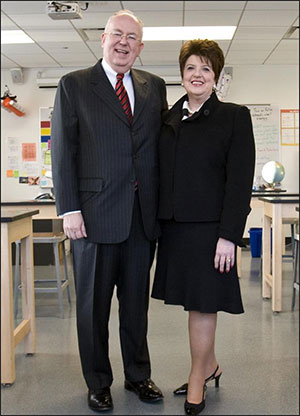
The Morgridge Institute launched in 2018 the John W. and Jeanne M. Rowe Center for Research in Virology, a new transformative research initiative made possible by the philanthropic support of John and Jeanne Rowe. The Rowes were integral to the early growth of the Morgridge Institute. John served on the Morgridge Board of Trustees and as chair of the WARF Board of Trustees, and together John and Jeanne have broadly supported the humanities and education at the grade school, high school and university levels.
John says that he and Jeanne have come to see biomedical research, and virology in particular, as an area where their philanthropic support can change lives and help people. “All of the work that the wonderful scientists are doing (in the virology team) could really save a huge part of humanity,” adds Jeanne. “Their work reaches out to so many people — and can help so many more.”
“The Rowes are tackling some of humanity’s biggest viral threats and supporting research that could help stop hundreds of disease-causing viruses. Along the way, we are likely to learn things that have other benefits we can’t even predict,” says Morgridge CEO Brad Schwartz. “All of us at the Morgridge Institute are honored by their philanthropy, and the confidence they have shown in us.”